Healthcare Jobs in Atlanta: 2026 Careers and Salary Guide
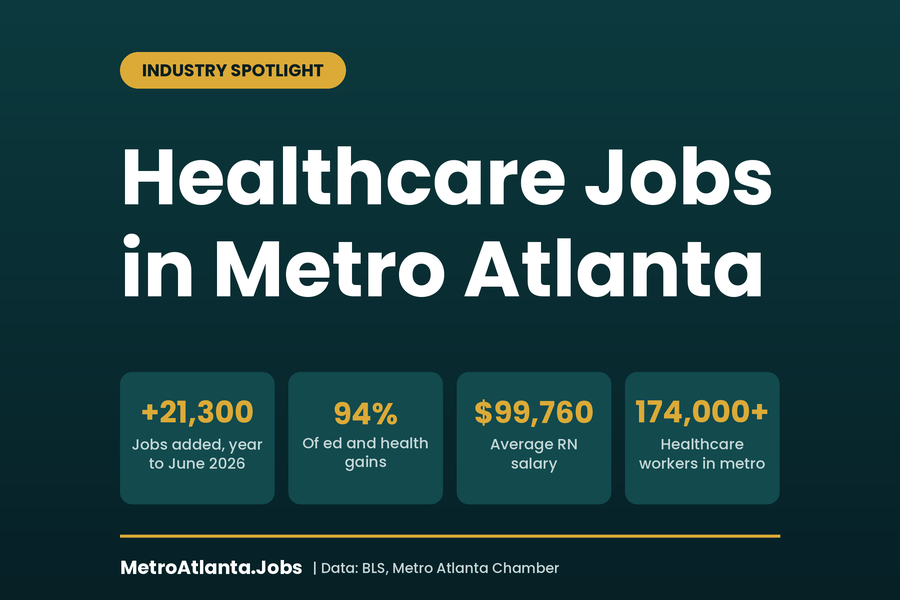
Healthcare is the only sector in metro Atlanta still adding jobs at scale. In the year ending June 2026, education and health services added 21,300 jobs while the entire metro economy added just 12,700, more than covering every job lost in construction, manufacturing, trade, and government combined [1]. If you are searching for healthcare jobs in Atlanta, you are searching the one part of this economy hiring in every county, at every experience level, in clinical and non-clinical roles alike. This guide is the hub for healthcare jobs in Atlanta: what the work pays, who is hiring, which roles are growing fastest, and how to get started whether you hold a license or have never worked in a hospital.
How strong is the healthcare job market in Atlanta in 2026?
Metro Atlanta means the 29-county Atlanta-Sandy Springs-Roswell metropolitan statistical area, running from Carroll and Coweta in the southwest to Lumpkin and Dawson in the north. Key facts on healthcare jobs in Atlanta as of 2026, per the U.S. Bureau of Labor Statistics and the Metro Atlanta Chamber:
Healthcare is the metro’s only growth engine. Metro Atlanta’s education and health services sector added 21,300 jobs in the year ending June 2026, more than the entire metro economy’s net gain of 12,700 jobs[1]. Health care and social assistance accounts for roughly 94 percent of that sector’s growth [2].
Every other Atlanta sector shrank or stalled. Over the same 12 months, metro Atlanta government employment fell 7,200, construction fell 4,100, trade and transportation fell 3,100, and manufacturing fell 2,400 [1].
The metro healthcare workforce is large. Metro Atlanta employs more than 174,000 people in healthcare practitioner and technical occupations, including more than 56,000 registered nurses, before counting aides, medical assistants, or billers [3].
Unemployment is low. Metro Atlanta’s unemployment rate was 3.5 percent in June 2026, nearly a full point below the U.S. rate of 4.4 percent [1].
The largest healthcare employer is Northside Hospital, at 32,000 employees across metro Atlanta, per the Metro Atlanta Chamber’s 2025 Top Employers survey [4].
Ready to look? Browse current openings on our healthcare and medical jobs page, then create a free job seeker profile so employers across all 29 counties can find you.
Who are the largest healthcare employers in metro Atlanta?
Healthcare is not just a growing sector here. It is the region’s dominant employer category. In the Metro Atlanta Chamber’s 2025 Top Employers survey, ranking full-time equivalent headcount across all 29 counties, three of the five largest employers in the region are hospital systems, and five of the top thirteen are healthcare organizations [4].
The major Atlanta hospital systems
Northside Hospital is the largest healthcare employer in metro Atlanta at 32,000 employees, second only to Delta Air Lines among all metro employers [4]. Known for oncology and one of the busiest labor and delivery services in the country, Northside hires in Sandy Springs, Canton, Cumming, and Lawrenceville.
Piedmont Healthcare employs 29,646 in metro Atlanta, third overall [4]. Piedmont Atlanta in Buckhead anchors a network reaching into the outer ring through Piedmont Fayette, Henry, Newnan, Rockdale, and Walton, the most accessible system for candidates outside the perimeter.
Wellstar Health System employs 21,020 in metro Atlanta, fifth overall [4]. Wellstar Kennestone in Marietta is one of the busiest hospitals in the Southeast, alongside Wellstar Cobb, Douglas, Paulding, and North Fulton. Wellstar is the dominant clinical employer on the metro’s west and northwest side.
Emory Healthcare is Georgia’s most comprehensive academic health system, with 11 hospital and provider locations, multiple Magnet-designated hospitals, and the Winship Cancer Institute, the state’s only National Cancer Institute designated comprehensive cancer center. Emory opens career paths community systems do not, including research coordination and clinical trials.
Children’s Healthcare of Atlanta employs 10,489, ninth among all metro employers [4]. Children’s is Georgia’s only freestanding pediatric health system, with three hospitals and 789 licensed beds. Its Arthur M. Blank Hospital, opened in 2024, expanded capacity and hiring.
Grady Health System employs 7,274 [4]. Grady Memorial in downtown Atlanta is one of the largest public hospitals in the country, the region’s Level 1 trauma center, and a teaching hospital affiliated with Emory and Morehouse School of Medicine.
The Atlanta healthcare employers most job seekers overlook
The hospital brands are only part of the Atlanta market, and the rest is easier to break into.
The same list includes the Centers for Disease Control and Prevention at 5,500, Tanner Health at 4,500, PruittHealth at 4,185 in skilled nursing and senior care, Elevance Health at 3,611 on the payer side, the Atlanta VA Medical Center at 3,600, Kaiser Permanente at 2,807, City of Hope at 2,000, the Shepherd Center at 1,486 in rehabilitation, Southern Regional Medical Center at 1,300, Quest Diagnostics and Morehouse School of Medicine at 1,000 each, and Aveanna Healthcare at 500 in home and community care [4].
Hundreds more metro Atlanta employers never make a top-employer list: independent physician practices, urgent care groups, dental offices, imaging centers, dialysis clinics, home health and hospice agencies, behavioral health practices, senior living communities, and staffing agencies. A large share of local hiring happens here.
What healthcare jobs are available in metro Atlanta?
Metro Atlanta healthcare jobs fall into twelve families. Every role below is hiring somewhere in the metro right now.
Nursing jobs in Atlanta
Registered nurse (RN) is the metro’s largest healthcare occupation, with demand strongest in ICU, emergency, labor and delivery, and surgical services. Licensed practical nurse (LPN) roles cluster in long-term care, physician offices, home health, and correctional health, and remain the fastest route from a one-year program to licensed clinical work. Certified nursing assistant (CNA) is the highest-volume entry point in the industry, with weeks of training rather than years. Nurse practitioner (NP) and clinical nurse specialist sit at the top of the ladder. Also active locally: travel and contract nursing, charge nurse and nurse manager, case management and utilization review nursing, school nursing, and patient care technician.
Advanced practice and physician jobs in Atlanta
Physician assistant (PA), certified registered nurse anesthetist (CRNA), and certified nurse midwife roles are expanding as Atlanta systems push care into suburban outpatient sites. Physician hiring is steady in family and internal medicine, hospitalist work, emergency medicine, psychiatry, and urgent care, with the widest gaps in the outer-ring counties.
Therapy and rehabilitation jobs in Atlanta
Physical therapist and physical therapist assistant, occupational therapist and occupational therapy assistant, speech-language pathologist and SLP assistant, respiratory therapist, recreational therapist, and athletic trainer. The Shepherd Center gives metro Atlanta an unusually deep rehabilitation employer base for a market this size.
Medical imaging jobs in Atlanta
Radiologic technologist, CT technologist, MRI technologist, diagnostic medical sonographer, nuclear medicine technologist, mammography technologist, and cardiovascular technologist. Most are two-year credentials leading straight to hospital pay scales.
Laboratory and surgical technology jobs in Atlanta
Clinical laboratory technologist and technician, medical laboratory scientist, histotechnician, phlebotomist, surgical technologist, and sterile processing technician. Phlebotomy and sterile processing are among the shortest training runways in metro Atlanta healthcare.
Pharmacy jobs in Atlanta
Pharmacist, pharmacy technician, pharmacy intern, and infusion pharmacy roles across retail, hospital, and specialty settings.
Dental jobs in Atlanta
Dentist, dental hygienist, dental assistant, orthodontic assistant, treatment coordinator, and dental front office. Private practice dental hiring is the least visible and least competitive corner of the Atlanta market.
Behavioral and mental health jobs in Atlanta
Licensed professional counselor (LPC), licensed clinical social worker (LCSW), licensed marriage and family therapist, psychiatrist, psychiatric nurse practitioner, psychiatric technician, behavioral health case manager, substance abuse counselor, peer support specialist, ABA therapist, and registered behavior technician (RBT). Behavioral health is the metro’s most persistently understaffed segment.
Home health, hospice, and long-term care jobs in Atlanta
Home health aide, personal care assistant, caregiver, certified medication aide, hospice aide, home health RN and LPN, hospice social worker, and skilled nursing facility staff. Aging outer-ring populations push this family hardest.
EMT and paramedic jobs in Atlanta
Emergency medical technician (EMT), advanced EMT, paramedic, emergency department technician, critical care transport, and 911 dispatch, across county EMS and private ambulance providers.
Medical office and administration jobs in Atlanta
Support and administrative roles are a substantial share of every metro Atlanta hospital’s payroll, and the part of the field job seekers miss most. Medical assistant, patient access representative, medical receptionist and front office, patient registration, scheduler, unit secretary, medical records specialist, medical biller and coder, prior authorization specialist, revenue cycle analyst, medical interpreter, patient transporter, environmental services (EVS), dietary aide and food service, central supply, hospital security, healthcare recruiter, credentialing specialist, compliance officer, practice administrator, and medical and health services manager.
Healthcare IT jobs in Atlanta
Epic and clinical applications analysts, healthcare data analysts, clinical informaticists, healthcare cybersecurity specialists, and digital health product managers are in demand at metro Atlanta’s major systems, the CDC, and the payers and health tech companies headquartered here. To compare that path against the wider market, see our Atlanta tech jobs guide.
What do healthcare jobs in Atlanta pay in 2026?
All wages below are annual mean wages for the Atlanta metro from the May 2025 Occupational Employment and Wage Statistics program [3][5].
Healthcare practitioner and technical occupations in metro Atlanta average $116,410 a year against a national $108,700, and healthcare support occupations average $40,200 against $40,800 [3][5]. Role for role, Atlanta lands within a few percent of national in either direction.
Advanced practice and pharmacy. Pharmacists average $139,250 and nurse practitioners $134,960, both within about 2 percent of national [3][5].
Therapy roles. Occupational therapists average $106,200, physical therapists $104,750, speech-language pathologists $97,230, and respiratory therapists $94,720 [3]. Respiratory therapy is the strongest local premium in the field at roughly 8.5 percent above national, with occupational therapy close behind at 4.9 percent [3][5].
Nursing. Registered nurses average $99,760, licensed practical and vocational nurses $64,890, and nursing assistants $40,570 [3].
Imaging, lab, and surgical tech. Dental hygienists average $96,990, diagnostic medical sonographers $90,680, radiologic technologists $82,290, clinical laboratory technologists $70,740, and surgical technologists $68,330 [3]. Lab technologists run about 5 percent above national; sonographers are the widest shortfall among technical roles [3][5].
Entry-level and support. Phlebotomists average $48,950, dental assistants $48,520, medical assistants $44,970, and home health and personal care aides $31,880 [3]. Phlebotomy pays roughly 7.5 percent above national, a standout among short-training roles, while home health aide pay is the one category where national clearly leads [3][5].
Two things reshape those numbers. Metro Atlanta’s cost of living runs roughly 4 to 5 percent below the national benchmark, more than covering the 1 to 3 percent shortfall on most clinical roles. And base pay is only part of a healthcare check: shift differentials, overtime, sign-on bonuses, and tuition assistance add thousands. The full role-by-role comparison is in healthcare salaries in Atlanta vs the U.S, with wider benchmarks in the Atlanta salary guide and our entry-level salary benchmarks.
Which healthcare jobs are growing fastest?
Federal projections for 2024 to 2034 put healthcare and social assistance as the fastest growing sector in the economy at 8.4 percent, adding roughly 2.0 million jobs, more than any of the other 19 sectors, against a total economy projected to grow just 3.1 percent [6].
The growth is uneven in a useful way. Healthcare support occupations are projected to grow 12.4 percent, well ahead of practitioner and technical occupations at 7.2 percent [6]. The aide, assistant, and technician tier is expanding faster than the licensed clinical tier, which favors anyone entering the field without a degree.
Nurse practitioners are the fastest growing healthcare occupation in the country at about 40 percent, with physician assistants and physical therapist assistants close behind [6][7]. Home health and personal care aides are projected to add more jobs than any of the 832 detailed occupations the federal government tracks [7].
One caution. Medical transcription is projected to decline about 5 percent, and federal analysts expect artificial intelligence to slow demand growth for medical records specialists and medical secretaries even as both keep growing [7]. On the administrative side, train toward coding, revenue cycle, and clinical applications rather than transcription or data entry.
Which metro Atlanta counties have the most healthcare jobs?
Healthcare employment reaches all 29 metro Atlanta counties, but density varies sharply.
Fulton County holds Georgia’s highest concentration of healthcare employment, with Emory, Grady, Children’s, Northside Atlanta, and the CDC headquarters. See our Fulton County jobs guide.
Cobb County is Wellstar territory, anchored by Kennestone in Marietta and Wellstar Cobb in Austell, plus outpatient sites through Kennesaw and Smyrna. See our Cobb County jobs guide.
Gwinnett County combines Northside Gwinnett in Lawrenceville with a fast-growing life sciences base, including the UCB investment at Rowen. See our Gwinnett County jobs guide and our Rowen project breakdown.
DeKalb County hosts Emory University Hospital, Emory Decatur, the Atlanta VA Medical Center, and Children’s Arthur M. Blank Hospital. See our DeKalb County jobs guide.
Cherokee and Forsyth Counties are the fastest-growing suburban healthcare markets in the state, driven by Northside Cherokee and Northside Forsyth. See our guides to Cherokee County and Forsyth County, plus what The Gathering at South Forsyth means for hiring.
Clayton County adds aviation medicine and occupational health around Hartsfield-Jackson. See our Clayton County jobs guide.
Henry, Paulding, Rockdale, Walton, Newton, and Coweta Counties are adding outpatient capacity as growth outruns the hospital base, with far less competition than inside the perimeter. See our guides to Henry County and Paulding County, and our overview of metro Atlanta’s population and job growth.
How do you get hired in Atlanta healthcare?
Start where the training is short. CNA, phlebotomy, medical assistant, sterile processing, EMT, and pharmacy technician credentials take months rather than years, and each puts you inside a system where internal transfers and tuition assistance open up. The Technical College System of Georgia runs these programs across metro Atlanta [8].
Target outpatient, not just hospitals. Urgent care, outpatient surgery centers, imaging centers, and specialty practices hire faster than hospitals and get clinical hours onto your resume sooner.
Get credentialed past the minimum. Specialty certifications move candidates to the top of the queue: CEN for emergency nursing, CCRN for critical care, CPC for coding, CST for surgical technology, board certification for NPs and PAs.
Do not skip the non-clinical roles. Wellstar, Northside, Piedmont, Emory, and Kaiser all hire for revenue cycle, IT, HR, marketing, supply chain, and operations. Hospital benefits, no clinical license, and a common route in for career changers. Our career pivot guide covers transferable skills.
Work the outer ring. As systems push outpatient capacity into Cherokee, Forsyth, Henry, Paulding, and Coweta, those roles draw a fraction of the applicants Fulton and DeKalb do.
Sharpen the application. Large systems screen through applicant tracking software before a human reads anything. Our Atlanta resume tips covers that, and our salary negotiation guide covers shift differentials and sign-on bonuses.
Frequently asked questions
What healthcare jobs are most in demand in Atlanta in 2026?
Registered nursing is the most in-demand clinical role in metro Atlanta, with the deepest need in ICU, emergency, labor and delivery, and surgical services. Nurse practitioners are the fastest growing healthcare occupation nationally at about 40 percent through 2034, with physician assistants and physical therapist assistants close behind [6][7]. On the support side, medical assistants, CNAs, home health aides, phlebotomists, sterile processing technicians, and patient access representatives hire continuously across all 29 counties. Behavioral health remains persistently understaffed.
How much do healthcare workers make in Atlanta?
Pay depends on the role. Healthcare practitioner and technical occupations in metro Atlanta average about $116,410 a year and healthcare support occupations about $40,200, per May 2025 federal wage data [3]. Individual roles run from roughly $31,880 for home health aides to $139,250 for pharmacists, with registered nurses at $99,760 and nurse practitioners at $134,960 [3].
What does a CNA make in Atlanta, GA?
Nursing assistants in metro Atlanta average about $40,570 a year, roughly 5 percent below the national mean of $42,700 [3][5]. Hospital-based CNA roles and those with specialty certifications sit toward the top of that range, while long-term care positions typically start lower. Home health and personal care aide work, which overlaps in skills, averages about $31,880 locally [3]. Browse current CNA and healthcare openings across metro Atlanta.
What do LPN jobs in Atlanta pay?
Licensed practical and vocational nurses in metro Atlanta average about $64,890 a year, compared with $67,050 nationally, a gap of roughly 3.2 percent that Atlanta’s lower cost of living largely offsets [3][5]. LPN roles here concentrate in long-term care, physician practices, home health, and correctional health rather than acute hospital units, and the credential takes about a year through a technical college program.
Which hospital in Atlanta pays nurses the most?
Nurse pay in Atlanta varies more by unit, shift, and experience than by employer. Registered nurses in metro Atlanta average $99,760 a year, and experienced RNs with certifications in ICU, OR, or labor and delivery routinely clear six figures at Northside, Piedmont, Wellstar, Emory, and Grady [3]. Night, weekend, and holiday differentials usually matter more to total pay than the base-rate gap between systems.
How do I get a healthcare job in Atlanta with no experience?
The most accessible entry points into Atlanta healthcare are certified nursing assistant, phlebotomist, medical assistant, sterile processing technician, EMT, pharmacy technician, patient access representative, and medical biller and coder. Each takes a certificate rather than a degree, most of them weeks to a year through the Technical College System of Georgia [8]. Non-clinical hospital roles in environmental services, food and nutrition, patient transport, scheduling, and security need no credential at all and carry the same benefits, tuition assistance, and internal transfer rights as clinical staff.
What are the largest healthcare employers in metro Atlanta?
By full-time equivalent headcount across the 29-county metro, Northside Hospital leads at 32,000, followed by Piedmont Healthcare at 29,646, Wellstar Health System at 21,020, Children’s Healthcare of Atlanta at 10,489, and Grady Health System at 7,274 [4]. Three of the five largest employers in the entire region are hospital systems [4]. Emory Healthcare is Georgia’s most comprehensive academic health system with 11 hospital and provider locations. The CDC, the Atlanta VA Medical Center, Kaiser Permanente, PruittHealth, Elevance Health, and Tanner Health also rank among the metro’s larger employers [4].
Are healthcare support and non-clinical jobs worth pursuing?
Yes. Support roles are a large share of metro Atlanta healthcare hiring, and federal projections favor them: healthcare support occupations are projected to grow 12.4 percent from 2024 to 2034, against 7.2 percent for licensed practitioner roles and 3.1 percent for the economy overall [6]. They carry the shortest training runway and open access to internal postings and tuition assistance. Approach transcription and data entry carefully, where automation is expected to reduce demand [7].
Is Atlanta a good city for a healthcare career?
Yes. Healthcare is the only sector in the metro adding jobs at scale, with education and health services up 21,300 over the year to June 2026 against a total metro gain of 12,700 [1]. Pay lands close to national for most roles while the cost of living runs 4 to 5 percent below it, and the employer base spans six major hospital systems, the CDC, large payers, an academic research enterprise, and hundreds of independent practices across 29 counties.
How do I find healthcare jobs near me in metro Atlanta?
Search by role and location on the healthcare and medical jobs page, which covers openings across all 29 metro counties rather than just the city of Atlanta. Create a free job seeker profile so local employers can find you directly, and turn on daily job alerts so new postings in your county reach you before the applicant pile builds.
Get started on your Atlanta healthcare job search
Browse Healthcare Jobs in Metro Atlanta: search current clinical and support openings across all 29 counties on the healthcare and medical jobs page.
Create a Free Job Seeker Profile: set up your job seeker profile so metro Atlanta employers can find you and you can apply faster.
Get Daily Atlanta Job Alerts: turn on job alerts so new healthcare roles in your county reach you first.
Compare Healthcare Pay: see how every major role stacks up against national in healthcare salaries in Atlanta vs the U.S..
Tighten Your Application: get past applicant tracking software with our Atlanta resume tips for 2026.
Know the Wider Market: see what else is hiring in our Atlanta job market and hiring trends.
Sources
1. U.S. Bureau of Labor Statistics, Atlanta, GA Area Economic Summary, updated August 3, 2026
2. U.S. Bureau of Labor Statistics, Atlanta Area Employment, Southeast Information Office news release
4. Metro Atlanta Chamber, 2025 Metro Atlanta Top Employers Survey
6.U.S. Bureau of Labor Statistics, Employment Projections 2024-2034 Summary
8. Technical College System of Georgia, healthcare and allied health certificate programs